Software that runs your operations smoothly, connects you more closely with parents, and affords you more time with the children.
Manage your entire school with one system seamlessly
Predict, manage, track, and boost enquiries and attendances
For parents to tune into your child’s day, anywhere, anytime
Assess and evaluate your staff's performance on one platform
Choosing the right software isn’t easy. But LittleLives isn’t just software, we put your unique needs to the forefront.
There are many alternative software options available, but LittleLives stands out
From single centre to national chains. See how LittleLives is already helping schools of all sizes
LittleLives enables better schools, better teachers, better parents, and most importantly, better students
It's not about the children's learning. Get our resources for yourself, staff, and parents - all for free.
LittleVoices, Big Ideas Partnering with industry experts, we deliver curated content, insights for educators and parents, inspiring growth and connection.
Ultimate Learning Hub: Training Courses, Podcasts, Ebooks, and More! Discover a world of knowledge with our curated videos, podcasts, ebooks, and training courses
Connect Globally Through Events, Conferences, and Communities! Engage with diverse communities, local events, and global conferences, fostering connections and building lasting relationships worldwide.



Check on Your School Staff, Too - They May Not Be Okay
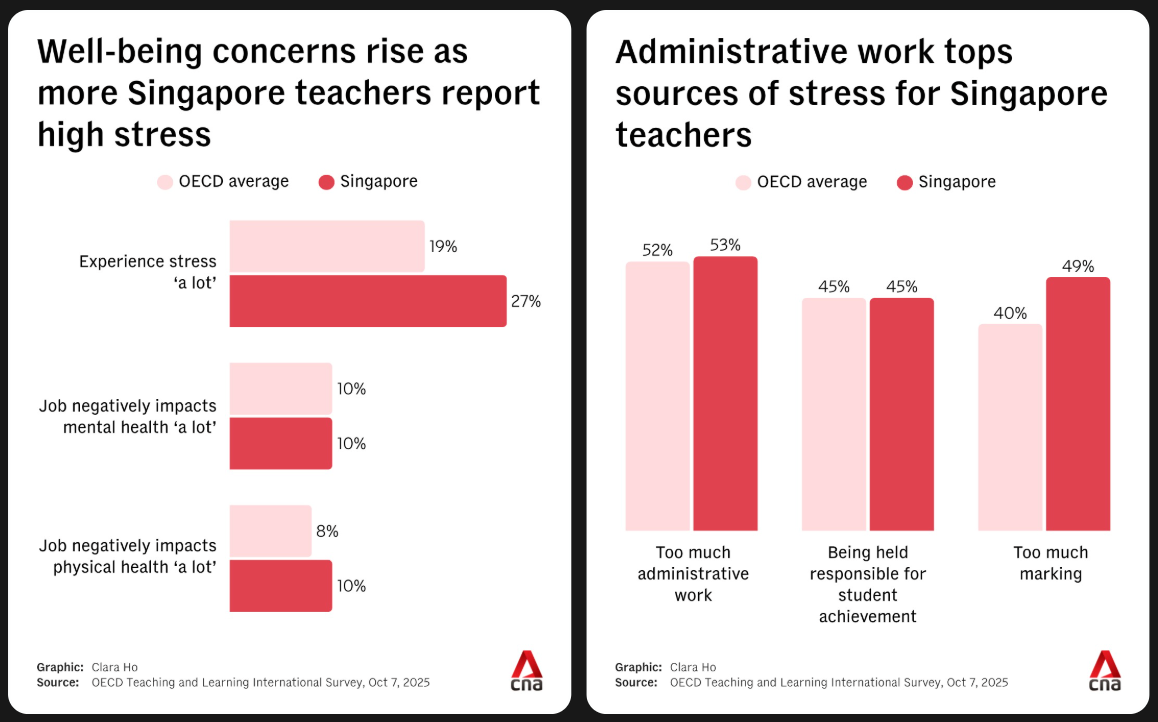
Most teachers do not start out feeling burned out. They begin their careers engaged, patient, and committed to their students. They stay back to prepare lessons, respond to parents, and put in extra effort to make sure things are done properly. For a period of time, this way of working feels sustainable. What changes is not their level of care. What changes is what they are asked to carry, every single day.
Based on Singapore’s MOE figures, over the years, teacher workload has remained stable in terms of total hours, at an average of 53 hours, with a significant portion spent on tasks unrelated to teaching.
Some examples of recurrent menial tasks:
- Daily or last-minute relief teacher planning
- Manually coordinating exam invigilation
- Uploading repeated data into multiple systems
- Chasing down information from students
- Managing classroom logistics, paperwork, and duplicated forms
It is not just workload. It is emotional load.
In many schools, the pressure does not come from one place. Teachers are managing classrooms while responding to parents who are anxious, frustrated, or simply looking for reassurance. Administrators are trying to keep operations running smoothly while handling issues that come in from all directions. Parents themselves are often under pressure, balancing work, family, and uncertainty. Over time, teachers are not just doing their jobs. They are also absorbing the stress around them.
A simple message from a parent is rarely just a message. It often carries concern, urgency, or frustration. Responding to it requires not just time, but attention and emotional energy. This is the part that is easy to miss.
Alongside this emotional load, the operational work continues to build. Teachers are updating attendance, uploading photos, responding to messages, repeating information, and resolving small administrative issues throughout the day. None of these tasks are unreasonable on their own. However, the work never ends and they can feel constant, and even overwhelming at times. They interrupt focus, extend the working day, and make it difficult to create uninterrupted time for teaching or preparation.
What burnout actually looks like in practice
Burnout in schools is often quiet. Teachers continue showing up. Classes continue running. From the outside, everything appears stable. But internally, there is a gradual shift. Teachers become more reactive, focusing on immediate tasks instead of planning ahead. Energy in the classroom becomes harder to sustain. Some begin to withdraw slightly, doing what is required but no longer going beyond it. Others start to wonder whether this is something they can continue long term in their careers. Not a sudden breakdown, but a slow depletion.
At the end of the day, teachers sit down to prepare for tomorrow’s lesson. Instead, they find themselves replying to parent messages, uploading photos, checking attendance discrepancies, and following up on administrative requests. Each task feels necessary. None of them feel optional. By the time they finish, it is late. Planning gets pushed to the next day.
The issue is not that teachers are unwilling to do the work. It is that the work leaves very little space for what matters most.
It is not just teachers feeling it
The unsung heroes of schools go by many names. Operations executive, administrators, administrative assistants - you name it. In many schools, administrators are carrying a similar weight. They are expected to stay composed, manage uncertainty, respond to parents, support teachers, and keep operations running at the same time. When something goes wrong, they are often the ones expected to step in and resolve it, regardless of the cause. Much of their time is spent managing situations that were not planned for, while trying to create a sense of stability for everyone else. As a result, the school continues to function - but often because people are constantly stepping in to hold things together.
Why additional support alone is not enough
In schools where teachers feel more in control of their work, the difference is often structural. Administrative tasks are streamlined so they do not interrupt teaching unnecessarily. Daily tasks are highlighted and prioritised for action, reducing information overload around what tasks to complete, by when, and who should complete those. Communication is organised in a way that reduces repeated questions and constant follow-ups. Information is accessible without needing to search across multiple channels.
Routine processes such as attendance, billing, and reporting are standardised, which reduces manual work and uncertainty.
The goal is not to remove responsibility. It is to reduce the friction that surrounds it, which allows teachers and administrators to get back to what they do best - ensure students get the best education and the attention they require through quality teaching and smooth operations of schools.
What this looks like day to day
Teachers are not switching between multiple platforms to complete basic tasks. Updates are shared once, clearly, instead of being repeated across different channels. Parent communication becomes more structured, so teachers are not expected to respond continuously throughout the day.
Administrators have clearer visibility and fewer ad-hoc issues to resolve. Instead of reacting to problems as they arise, they are able to focus more on supporting staff and improving the school.
“It has really improved how we communicate with parents. They are much more aware of their child’s learning progress now. It has also made things easier for our teachers and staff. Administrative work is more distributed, and teachers can reach out to parents directly while principals still have visibility.” - Principal, SNS
The cost of leaving it unaddressed
When burnout is not addressed at a structural level, it begins to affect the entire school.
Teacher turnover increases, creating a constant cycle of hiring and training. Administrators spend more time managing issues and less time planning ahead. Team morale becomes more fragile, and consistency in the classroom becomes harder to maintain.
Over time, this impacts not just staff, but the experience of students and parents as well.
At the end of the day, it is worth asking whether your team is leaving work with enough energy to return the next day and do it again.
If you are exploring ways to reduce unnecessary workload and create a more sustainable environment for your team, you can learn more here:
👉 See how schools reduce teacher workload without compromising quality


 Singapore
 Malaysia
 Vietnam
 Indonesia
